
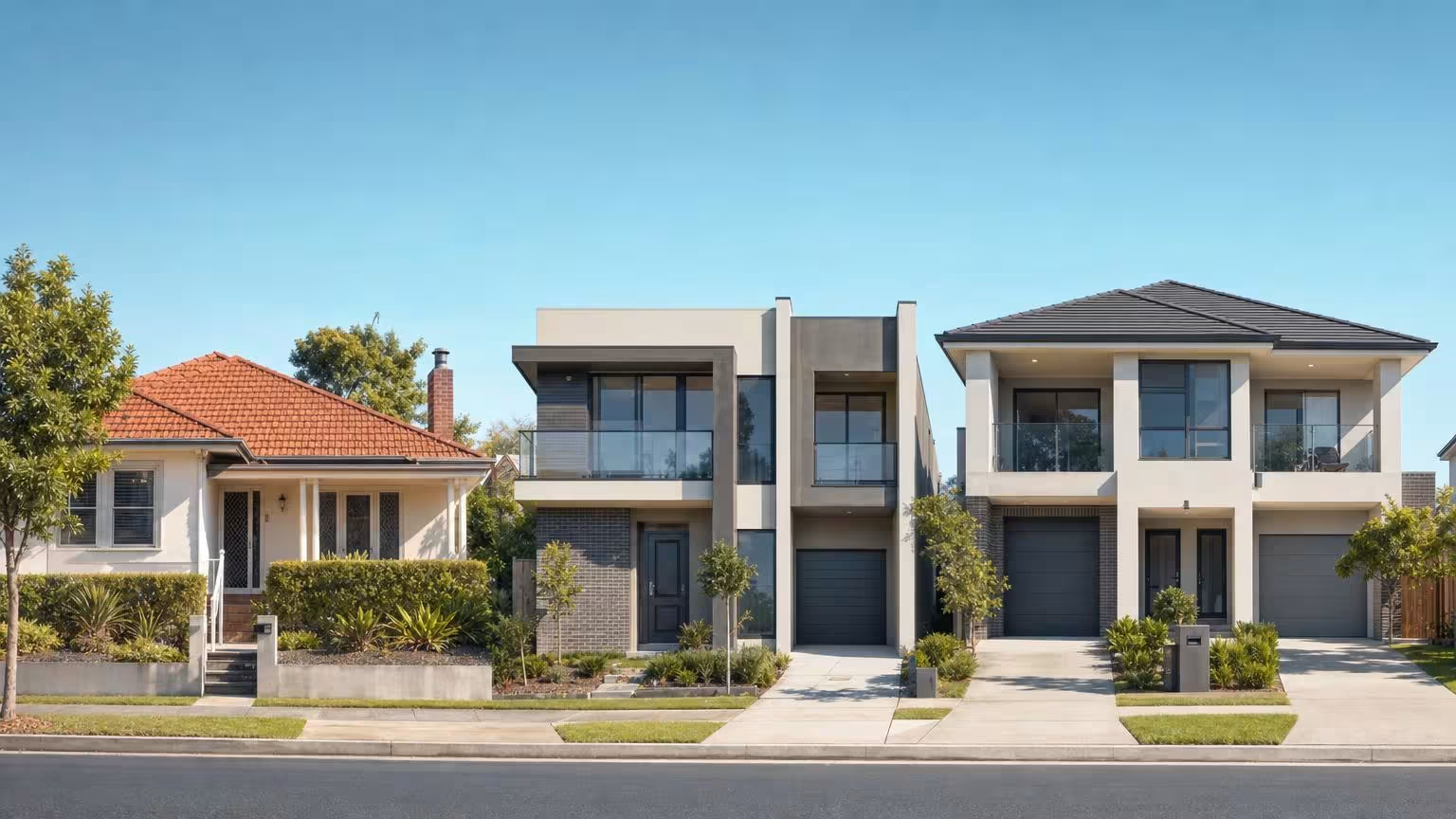
What are the six strategies?
All six are available to an ordinary investor in Queensland and New South Wales, as established homes or new builds. In order of net cash yield:
- Rent-to-Sell: a standard house let on a Rent-to-Sell agreement. The tenant pays market rent plus a fixed weekly contribution of 50% of year-one rent, holds an option to buy from year four to year eight, and their contributions become their deposit at settlement.
- NDIS (SDA): Specialist Disability Accommodation. Purpose-built or heavily modified housing let to NDIS participants, with payments set by a published pricing framework rather than the rental market.
- Rooming: a home let room by room under rooming-house or boarding-house law, with shared facilities, per-room agreements and ongoing compliance. It usually needs council approval.
- Co-living: a home designed or adapted for several unrelated people, with private rooms and shared living areas on individual agreements. In Queensland, four or more residents makes it a registrable residential service; in NSW it needs development consent.
- Dual occupancy: one title with two self-contained dwellings, such as a duplex or a house with a legal granny flat, let to two households.
- Traditional: a standard investment property on an ordinary lease, re-let at the end of each term at whatever the market pays.
How much cash do you need to get in?
We base the Rent-to-Sell and traditional figures on a $600,000 entry price, because that is about the cheapest you can buy a house for across Queensland and New South Wales. The other four use their typical entry prices: $800,000 for co-living, $900,000 for dual occupancy and $1.4 million for NDIS and rooming.
On an established property, the cash needed before the first rent payment starts at $157,625 for Rent-to-Sell and $160,625 for a traditional purchase. It climbs past $500,000 for NDIS and rooming, mostly because of the price and the 30% deposit. To total the costs for a specific price, state and deposit, use the acquisition cost calculator.
- Rent-to-Sell$157,625
- Traditional$160,625
- Co-living$224,625
- Dual occupancy$234,125
- NDIS (SDA)$513,525
- Rooming$543,525
| Deposit | Transfer duty | Other costs | Total, from | |
|---|---|---|---|---|
| Rent-to-Sell | $120,000 | $20,025 | $17,600 | $157,625 |
| Traditional | $120,000 | $20,025 | $20,600 | $160,625 |
| Co-living | $160,000 | $29,025 | $35,600 | $224,625 |
| Dual occupancy | $180,000 | $33,525 | $20,600 | $234,125 |
| NDIS (SDA) | $420,000 | $61,025 | $32,500 | $513,525 |
| Rooming | $420,000 | $61,025 | $62,500 | $543,525 |
A few lines explain most of the gap:
- Deposit. Lenders treat NDIS and rooming as specialised or commercial security, so they want 30% down from a smaller panel of lenders. The other four are ordinary residential security at 20%.
- Finance setup. Specialised lending typically needs a paid valuation (from $2,000) and charges around 1% of the loan to establish, which is $10,000 or more at these loan sizes. Residential lending costs about $600.
- Fit-out. Co-living and rooming are let furnished and must meet room, fire and amenity standards: from $15,000 for co-living and $30,000 for rooming.
- Rent-to-Sell setup fee. A one-off $9,900 that covers buyers agency, conveyancing and independent legal advice, rental marketing and letting, and the sales marketing at the end of the term. On the other five those are paid separately.
Which strategy nets the most cash during the hold period?
Measured on net cash yield, Rent-to-Sell nets the most of the six at 5.7%, followed by NDIS at 4.0%, rooming at 3.5%, co-living at 3.3%, dual occupancy at 3.2% and a traditional lease at 3.0%.
Net cash yield is the cash the property collects each year, less what the owner pays to run it, less any extra interest the lender charges above the standard investor rate. It is stated against the purchase price, so a $600,000 house and a $1.4 million rooming house can be compared fairly. Headline rent yield can't do that, because it ignores the costs that come with the higher-rent strategies.
Every figure here comes from the entry price. Rent-to-Sell and traditional are both on $600,000, co-living on $800,000, dual occupancy on $900,000, and NDIS and rooming on $1.4 million. The percentage next to each dollar figure is that line as a share of the entry price, so the net cash percentage is the net cash yield.
- Rent-to-Sell$34,200 (5.7%)
- NDIS (SDA)$56,000 (4.0%)
- Rooming$49,000 (3.5%)
- Co-living$26,400 (3.3%)
- Dual occupancy$28,800 (3.2%)
- Traditional$18,000 (3.0%)
| Entry price | Cash collected | Hold costs | Finance margin | Net cash | |
|---|---|---|---|---|---|
| Rent-to-Sell | $600,000 | $42,000 (7.0%) | −$7,800 (1.3%) | — | $34,200 (5.7%) |
| NDIS (SDA) | $1,400,000 | $133,000 (9.5%) | −$49,000 (3.5%) | −$28,000 (2.0%) | $56,000 (4.0%) |
| Rooming | $1,400,000 | $98,000 (7.0%) | −$35,000 (2.5%) | −$14,000 (1.0%) | $49,000 (3.5%) |
| Co-living | $800,000 | $46,400 (5.8%) | −$16,000 (2.0%) | −$4,000 (0.5%) | $26,400 (3.3%) |
| Dual occupancy | $900,000 | $55,800 (6.2%) | −$18,000 (2.0%) | −$9,000 (1.0%) | $28,800 (3.2%) |
| Traditional | $600,000 | $27,000 (4.5%) | −$9,000 (1.5%) | — | $18,000 (3.0%) |
NDIS has the highest cash yield at 9.5%, but hold costs of 3.5% a year and a finance margin of around 2% take it down to 4.0%. Rent-to-Sell starts lower at 7.0% and keeps most of it, because it runs on an ordinary house, an ordinary mortgage and one tenant.
In dollars, the bigger properties earn more: NDIS nets $56,000 a year on $1.4 million and Rent-to-Sell $34,200 on $600,000. As a share of the price, Rent-to-Sell keeps 5.7% and NDIS 4.0%, and NDIS needs more than three times the upfront cash to get there.
Rent-to-Sell's cash collected is $28,200 of market rent plus $13,800 of tenant contributions. On the same $600,000 house, a traditional lease collects $27,000 and nets $18,000, so the difference is $16,200 a year, or $113,400 over seven years. Try it on your own rent with the weekly cashflow calculator.
Hold period costs
- Rent-to-SellNone
- NDIS (SDA)Certification and audit
- RoomingAccreditation and fire
- Co-livingRegistration (QLD, 4+)
- Dual occupancyNone
- TraditionalNone
| Utilities paid by | Tenancies to manage | Vacancy assumed | Ongoing compliance | |
|---|---|---|---|---|
| Rent-to-Sell | Tenant | 1 | None, contracted | None |
| NDIS (SDA) | Participant | Per resident | 7.8%–25.5% | Certification and audit |
| Rooming | Owner | Per room | No data | Accreditation and fire |
| Co-living | Owner | Per room | No data | Registration (QLD, 4+) |
| Dual occupancy | Tenants | 2 | 0.9%–1.7% | None |
| Traditional | Tenant | 1 | 0.9%–1.7% | None |
What happens when you sell?
Rent-to-Sell is the only one of the six with a contracted minimum resale price. The sale is at the higher of that minimum or an independent valuation, so there is no bearish case in the table below. The other five sell at whatever the market pays on the day. The minimum resale price calculator shows the floor for any price and exit year.
- Rent-to-Sell$950,933
- Traditional$950,933
- Co-living$1,267,911
- Dual occupancy$1,426,400
- NDIS (SDA)$2,218,844
- Rooming$2,218,844
| Entry price | Bearish, 2.5% | Contract minimum | Average, 6.8% | High, 8.5% | |
|---|---|---|---|---|---|
| Rent-to-Sell | $600,000 | — | $804,057 | $950,933 | $1,062,085 |
| Traditional | $600,000 | $713,211 | — | $950,933 | $1,062,085 |
| Co-living | $800,000 | $950,949 | — | $1,267,911 | $1,416,114 |
| Dual occupancy | $900,000 | $1,069,817 | — | $1,426,400 | $1,593,128 |
| NDIS (SDA) | $1,400,000 | $1,664,160 | — | $2,218,844 | $2,478,199 |
| Rooming | $1,400,000 | $1,664,160 | — | $2,218,844 | $2,478,199 |
The table applies the same growth rate to every strategy, which flatters the four specialised ones. NDIS, rooming, co-living and dual occupancy are often valued on capitalised rent: the rent divided by a cap rate, rather than comparable house sales. Their value can only grow as fast as their rent does, and it drops if cap rates rise. A standard house, including one let under Rent-to-Sell, is valued on comparable sales and moves with the housing market.
Why does Rent-to-Sell come out ahead?
Four things, and none of them depend on a special kind of property:
- The contribution. The tenant pays market rent plus a fixed 50% of year-one rent every week, which lifts cash yield from 4.7% to 7.0% on the same house.
- No vacancy. The tenant is contracted before settlement on a lease of up to eight years, so no vacancy is assumed.
- Standard finance. A lender prices the security, not the lease. An ordinary house on an ordinary investor mortgage is prime, whoever the tenant is, so there is no finance margin.
- Low running costs. One tenancy, the tenant pays utilities, and there is no registration, accreditation or fire compliance. Hold costs measured across our case studies average 1.3% a year.
Average purchase price
$791,187
Average cash yield
7.0%
Hold costs, a year
1.3%
Those are the averages across our published Rent-to-Sell case studies in Townsville, Ipswich, Moreton Bay, Logan and Cairns. Each property was let before settlement with the contribution already running. You can see every one of them, with photos and weekly figures, in our Rent-to-Sell vs traditional leasing comparison.
When might another strategy suit you better?
Net cash yield is one measure, and the others have their place:
- NDIS and rooming earn the most dollars a year. If you have $500,000 or more to put in, can get specialist finance, and are comfortable with accreditation, audits and per-room management, the income is large.
- Dual occupancy suits investors who want two incomes from one title on a 20% deposit, with no special compliance.
- Co-living earns more rent than a single lease for a smaller outlay than rooming, but the owner pays utilities and each room is its own tenancy to manage.
- A traditional lease has the most freedom. You can sell whenever you like, re-let at market rent, and there is no contract with the tenant beyond the lease.
What are the trade-offs of Rent-to-Sell?
Rent-to-Sell has the best net yield of the six, but it has trade-offs you should know before you commit:
- The contributions are credited to the tenant at settlement, so they reduce what is paid for the property at the end. They are cashflow brought forward, not extra growth.
- Rent reviews are capped at 4% a year. If market rents run hotter than that, a standard re-let would earn more rent.
- You sell in the tenant's window, between year four and year eight, with year seven the expected purchase year. That is less flexible than a normal lease if you want out early.
- The tenant may not complete. If they don't, you can sell on the open market, with the contracted minimum still applying under the agreement, or keep the property.
We cover each of these in more detail in Rent-to-Sell vs traditional leasing.
Frequently asked questions
Of the six residential strategies PublicSquare compared in QLD and NSW, Rent-to-Sell has the highest net cash yield at 5.7%, ahead of NDIS (4.0%), rooming (3.5%), co-living (3.3%), dual occupancy (3.2%) and a traditional lease (3.0%). NDIS has the highest gross yield, but its running costs and finance margin are much higher.
Sources
Written by

Property Lead
Licensed agent · Former mortgage broker
I was a mortgage broker before joining PublicSquare, so I look at every property and every purchase the way a lender would. I now lead the property side of the program, helping homebuyers from their first info session through to move-in, and working with our buyers agency team on each acquisition for our investors.
Reviewed by

Founder & CEO
Licensed real estate agent
I started PublicSquare in 2021 to give homebuyers a real path to ownership without a deposit, and investors a stronger-cashflow alternative to a standard rental. I hold real estate licences in Queensland and New South Wales and personally review every property that enters the program.
How this comparison was made
Written by Jarrod Wills (Property Lead) and reviewed for accuracy by Dean Arnold (Founder & CEO) before publishing. Program terms are quoted from PublicSquare's own agreements, and market figures are referenced to the sources listed above. We check it again whenever the numbers change; it was last updated 26 September 2026.
For more information, visit our Editorial Guidelines.
Read more about Rent-to-Sell.
This article is general information only and does not take your personal circumstances into account. PublicSquare is a licensed real estate agency, not a financial adviser or credit provider. Consider seeking independent advice before making a decision.

.png)







.jpg)